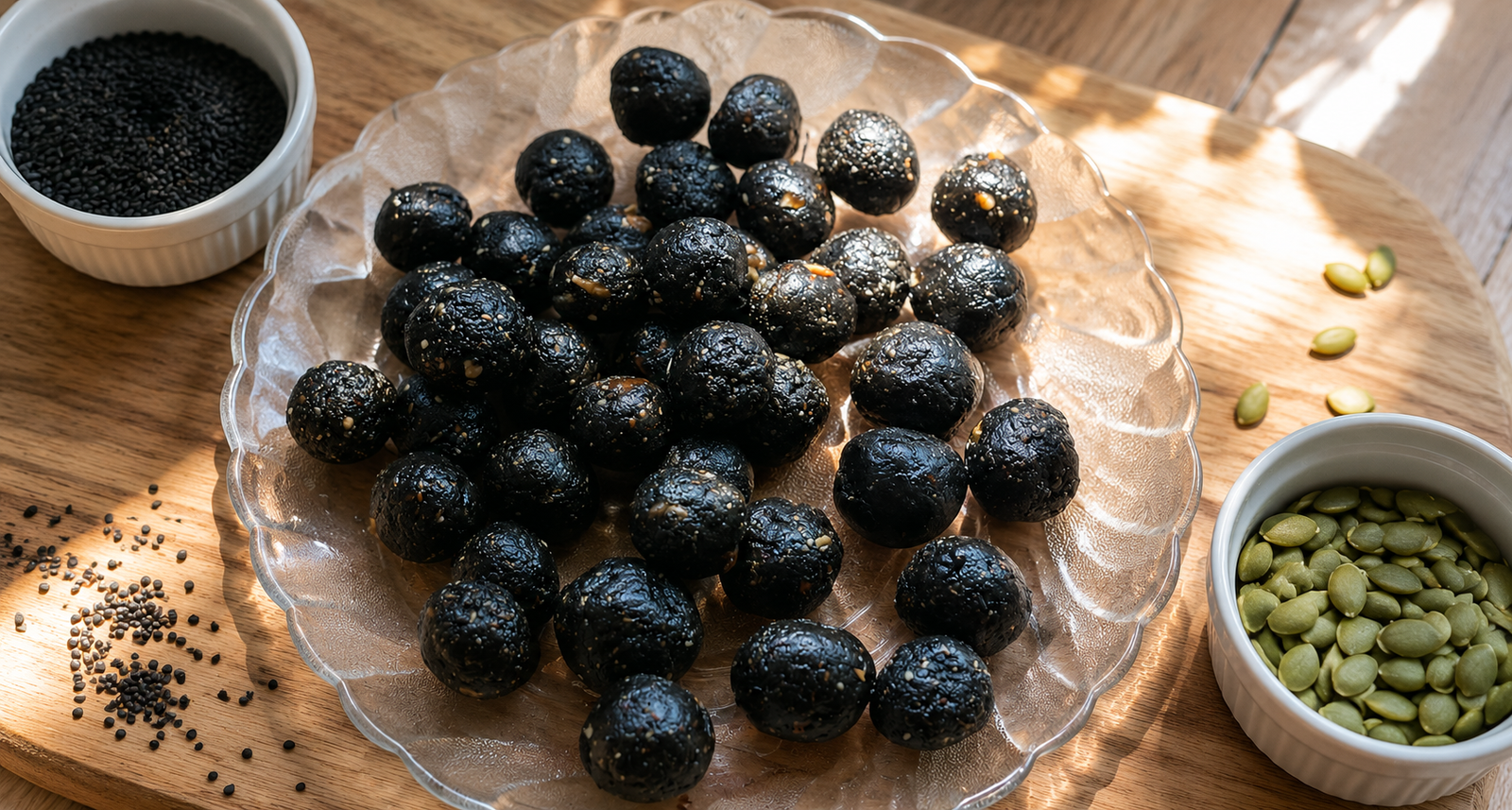
No Sugar Calcium Rich Black Sesame Seeds Laddu -Dates, Walnuts & Pumpkin Seeds
📌 Quick Guide
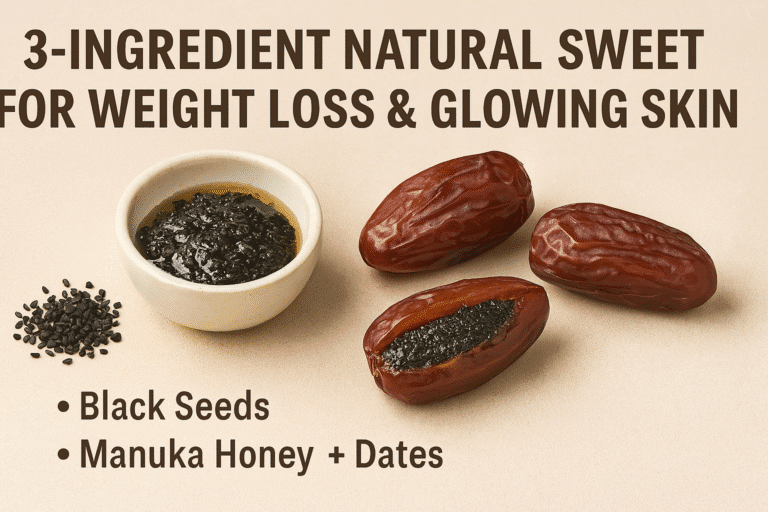
What it is:These Black Sesame Seeds Laddu has Dry-roasted black sesame seeds, pumpkin seeds, walnuts, and hemp seeds blended with pre-soaked dates, a spoon of honey, and ghee -shaped by hand into laddus with no sugar, no water, no baking
Why it works: Every ingredient earns its place — calcium, magnesium, omega-3, healthy fats, and natural sweetness all from whole food, nothing processed
IBS-friendly: Yes-no refined sugar, no maida, no artificial anything. Dates and seeds are gentle on the gut in moderate amounts
Makes: ~23 laddus | Stores: 2 weeks in the fridge
Calories: ~290 kcal | Protein: ~8.5g (per 2 laddus)
For a long time after my IBS diagnosis, I thought sweets were just off the table. On top of that, I’m lactose intolerant-and the base of almost every Indian sweet is milk or something made from it. Khoya, paneer, condensed milk, malai. Those aren’t my things anymore. It’s not only my body rejecting them; my soul stopped wanting them too.
My dietitian told me to stop eating them. It turned out the problem was never sweetness. It was refined sugar-the kind in a shop-bought mithai or a packaged laddu-and the dairy underneath it. A date that’s been soaking in water overnight until it’s soft enough to blend is a completely different thing, and my gut treats it differently too.
That distinction took me a while to actually believe. I kept waiting for a date-sweetened thing to taste like a compromise, like something I was eating because I could not have the real thing. These black sesame seeds laddu are not a compromise. They are what I actually want to eat now.
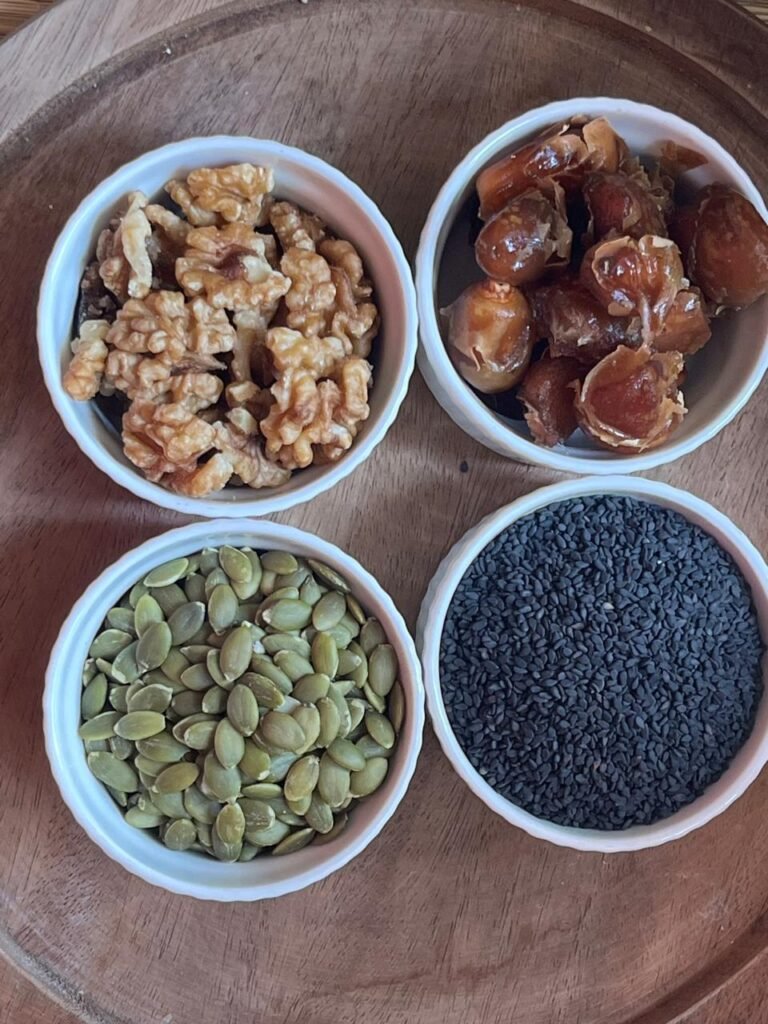
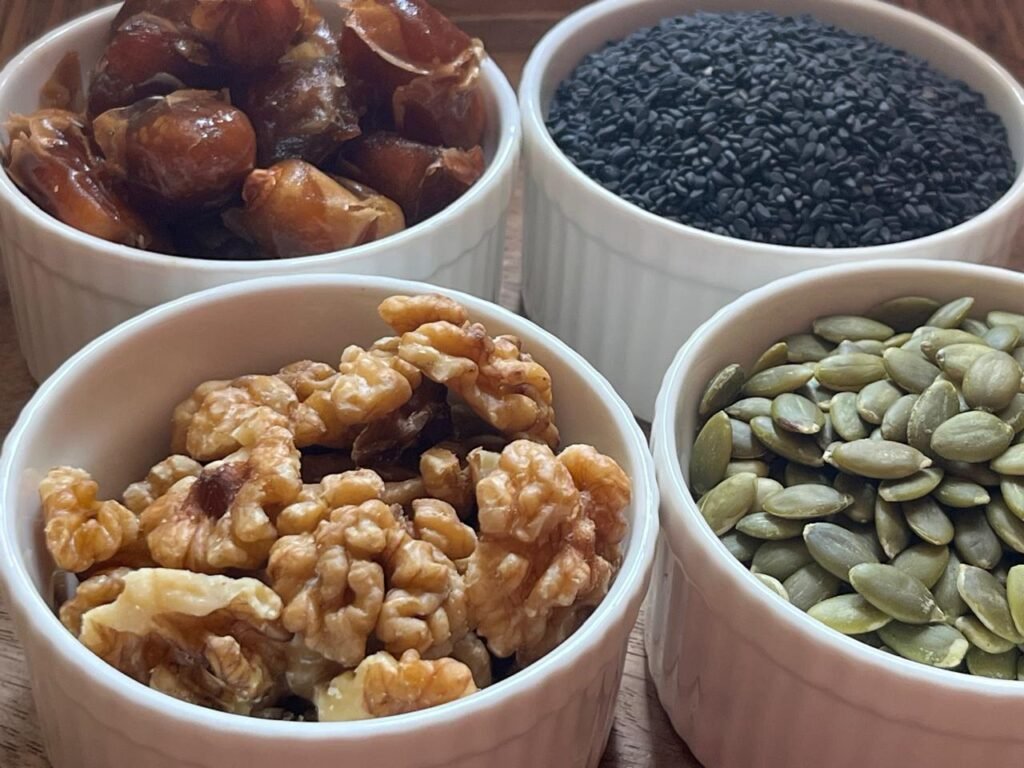
Every ingredient in them is there because it does something. The black sesame seeds (kaala til) bring calcium-more per gram than most dairy. The pumpkin seeds (kaddoo ke beej) bring magnesium. The walnuts (akhrot) bring omega-3. The Sunflower seeds bring Vitamin E. The dates bring sweetness and fiber. A spoon of ghee and a touch of honey to bring it all together into something you can shape with your hands.
No water. No sugar. No baking. One batch makes roughly 23 laddus and they live in the fridge for two weeks. I make these every other Sunday and that is my sweet craving sorted for the fortnight.
Table of Contents
Why Are Black Sesame Seeds Laddu Better Than Taking a Calcium Supplement?
I used to buy calcium supplements. The kind that come in big white bottles and taste like chalky fruit. I took them inconsistently because I kept forgetting, they made me feel vaguely nauseous on an empty stomach, and I was never quite sure they were actually absorbing properly.
My dietitian was the one who pointed out that calcium from whole food sources comes packaged with the cofactors that help the body absorb it-magnesium, healthy fats, vitamin K-in ways that isolated supplements often do not.
Black sesame seeds specifically have one of the highest calcium concentrations of any plant food. One cup of black sesame seeds contains over 1,400mg of calcium – more than the daily adult recommended intake in a single ingredient.
A serving of two black sesame seeds laddu gives you approximately 150mg of calcium. That is 15% of your daily requirement from two small rounds of something that actually tastes good. Eat two laddus a day for two weeks- which is exactly how long one batch lasts — and you have been adding consistent, food-sourced calcium to your diet without thinking about it.
This is what my dietitian means when she says food-first over supplements where possible. The calcium in kaala til comes with sesamin and sesamolin, lignans that have been studied for their role in bone health and antioxidant activity. A calcium carbonate tablet does not come with any of that.
What Does Each Ingredient in These Laddus Actually Do?
This is the part I want to spend time on because every single ingredient in this recipe has a specific reason to be there- and knowing that reason is what makes you actually want to eat these rather than just eating them because you think you should.
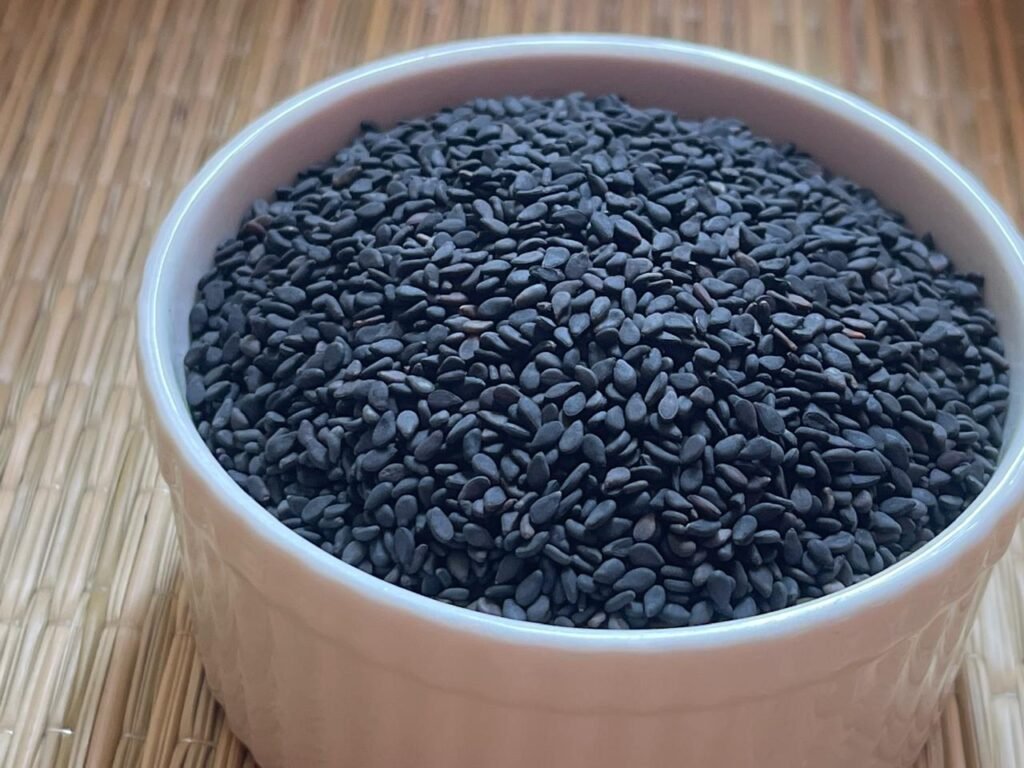
Are Black Sesame Seeds (Kaala Til) Really That Good for Calcium?
Yes-and this surprises most people, including me when I first looked it up. Black sesame seeds contain approximately 975mg of calcium per 100g. Full-fat milk contains about 120mg per 100g. Paneer contains about 480mg per 100g. Black sesame (kaala til) has roughly twice the calcium of paneer, gram for gram.
The black variety specifically has more calcium, more antioxidants, and a more intense, nuttier flavour than white sesame. The dark colour comes from the outer hull remaining intact- and that hull is where a significant portion of the nutrients live.
Dry roasting black sesame before blending opens the seeds slightly and makes those nutrients more bioavailable. It also develops the flavour-raw black sesame is sharp and slightly bitter; roasted black sesame is deep, nutty, and almost savoury in a way that works beautifully against the sweetness of dates.
Black sesame seeds are also the backbone of the black sesame seeds laddu flavour-every other ingredient builds around them.
Do Pumpkin Seeds (Kaddoo ke Beej) Actually Help with Magnesium ?
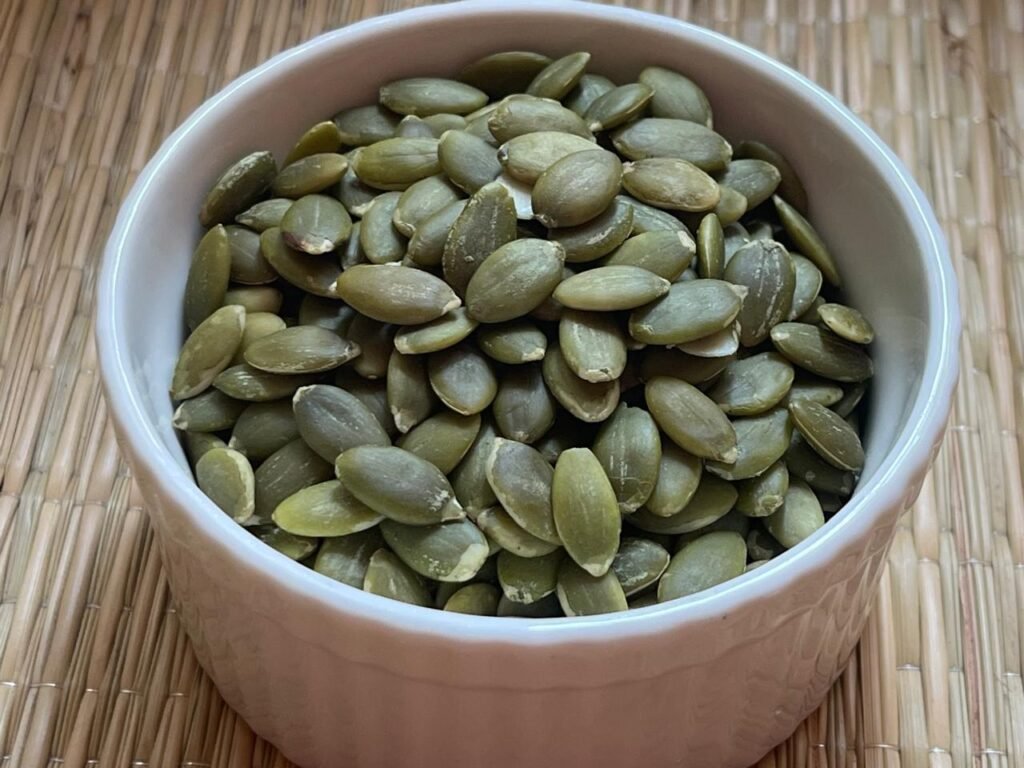
Pumpkin seeds are one of the richest plant sources of magnesium available-approximately 535mg of magnesium per 100g, which is roughly 127% of the adult daily requirement. Magnesium is involved in over 300 enzymatic reactions in the body, including muscle function, nerve transmission, and critically for IBS-gut motility.
Low magnesium is associated with constipation and irregular bowel movements. My dietitian brought this up specifically in the context of IBS: getting consistent magnesium from food rather than just supplementing is more effective long-term because it comes in the right form and quantity for the body to regulate.
Pumpkin seeds also bring zinc (important for immune function and gut lining repair), iron, and a solid protein contribution-30g of protein per 100g, which is higher than most nuts.
Dry roasting them for this black sesame seeds laddu brings out a toasty, slightly sweet flavour that blends seamlessly with the sesame. Raw pumpkin seeds have a grassy note that disappears with heat.
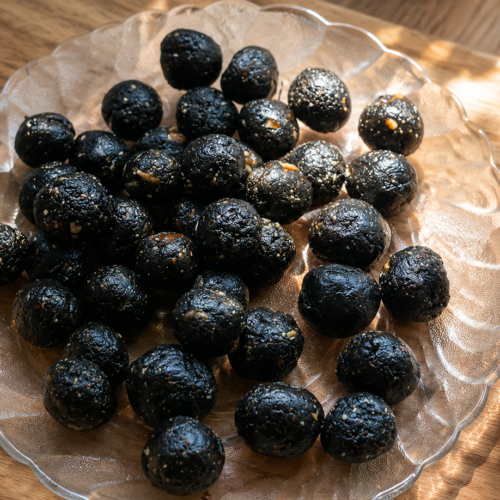
Black Sesame Seeds Laddu – No Sugar, Calcium Rich

Equipment
- 1 pan
- 1 Spatula
- 1 Mixer Grinder
Ingredients
- cup black sesame seeds kaala til — 144g
- 1 cup pumpkin seeds kaddoo ke beej — 129g
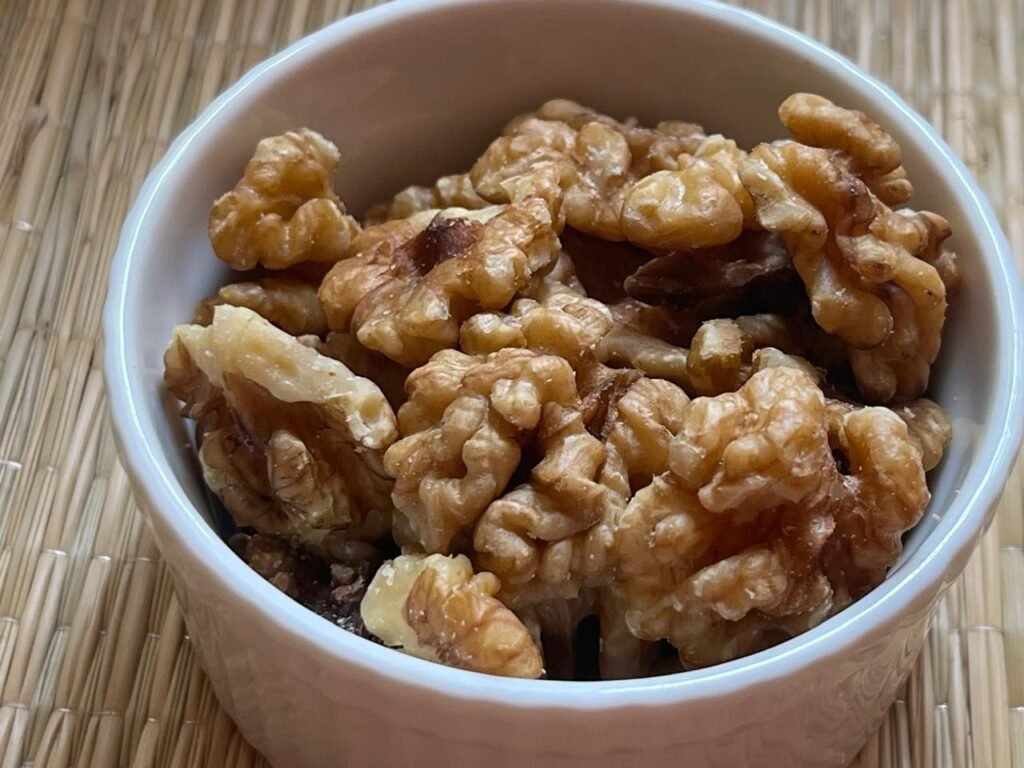
- 1½ cups walnuts akhrot — 180g
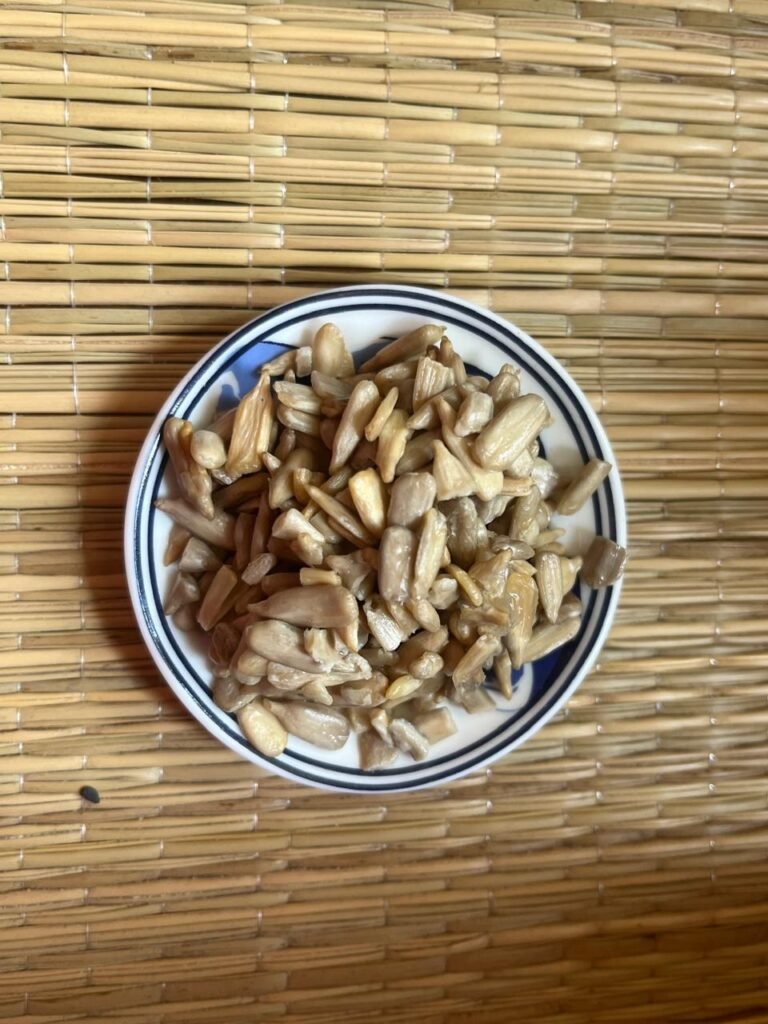
- 1 tbsp sunflower seeds surajmukhi ke beej— 10g
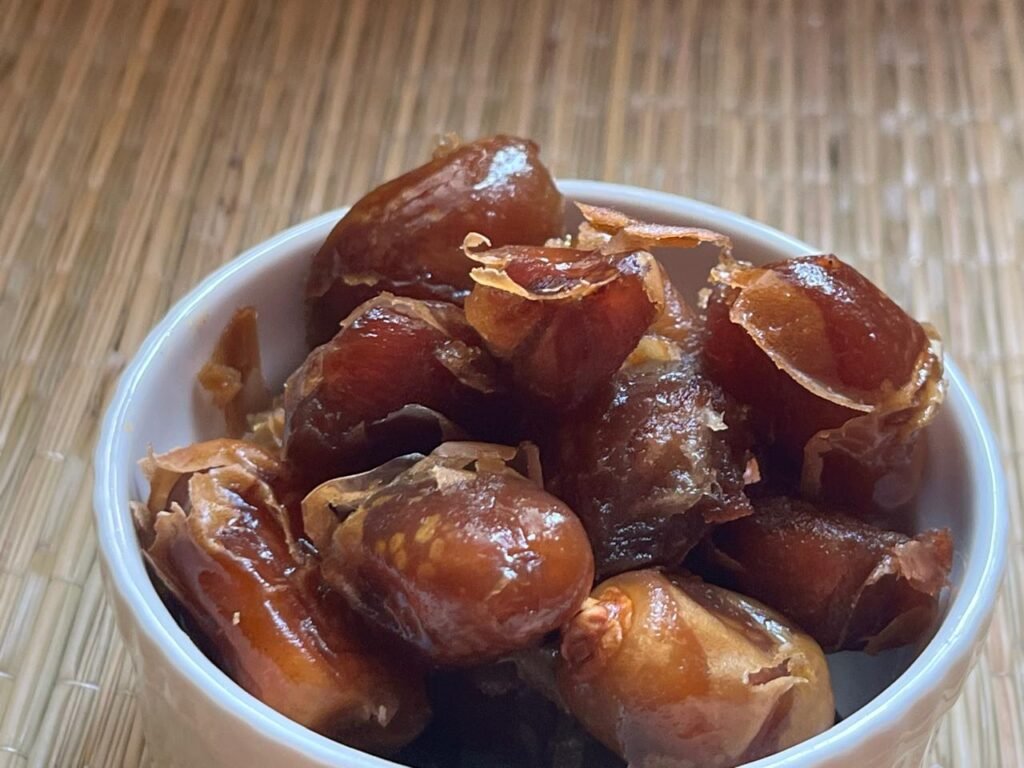
- 1 cup dates pitted (khajur), pre-soaked in warm water 20–30 minutes — 178g
- 1½ tsp ghee
- 1 honey — add gradually just enough to bind (not liquid)
Instructions
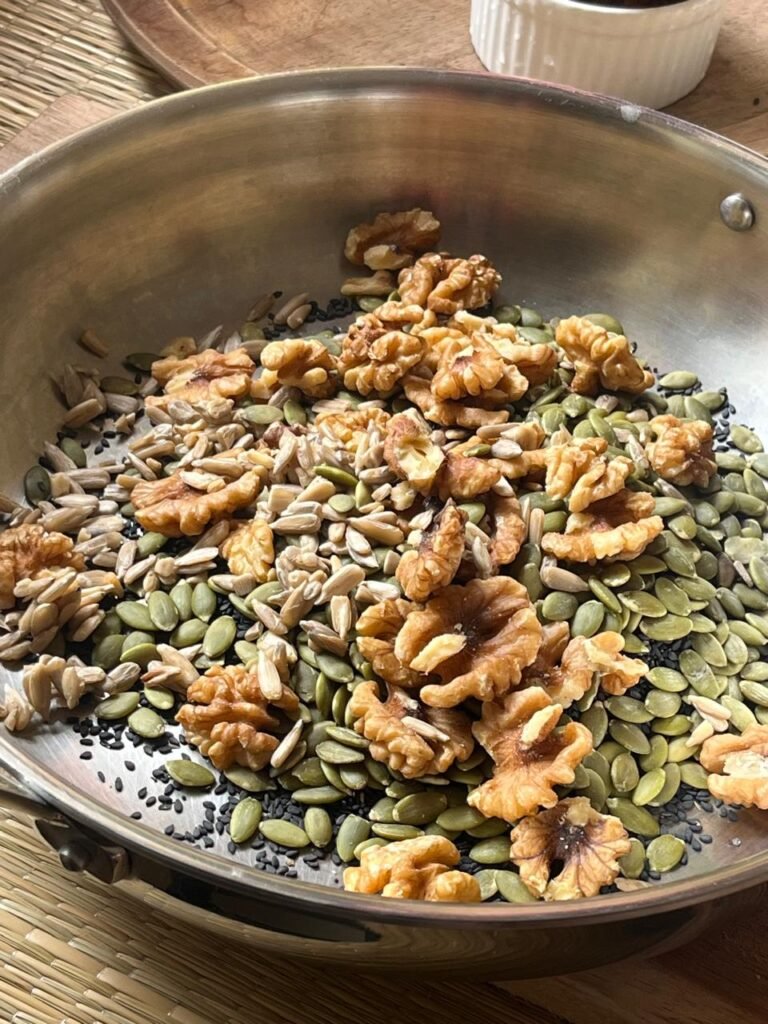
- Dry roast seeds in batches — Heat a heavy pan on medium-low, no oil. Roast black sesame seeds 2–3 minutes, stirring constantly, until they pop and smell nutty. Remove to a plate. Roast pumpkin seeds 3–4 minutes until slightly puffed. Remove. Roast walnuts 2 minutes until fragrant — watch closely, they burn fast. Add sunflower seeds last for 30 seconds only. Cool everything completely on a plate before blending.
- Soak the dates — While seeds cool, soak pitted dates in warm water for 20–30 minutes. Drain completely — no water in the final mixture.
- Blend in stages — Add cooled roasted seeds and walnuts to a mixer or food processor. Pulse to a coarse, textured grind — not fine powder. Add drained dates, ghee, and 1 tsp honey. Pulse in short bursts until the mixture comes together like rough dough. Add second tsp of honey only if needed to bind. The mixture should hold shape when pressed — not wet, not crumbly.
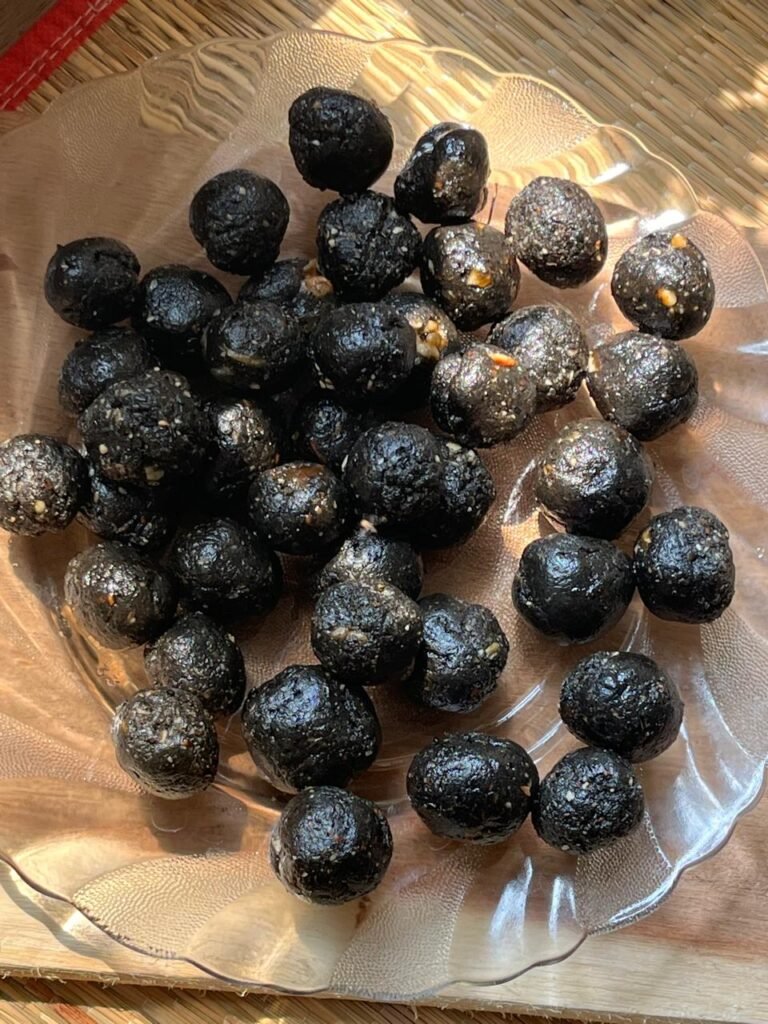
- Shape by hand — Take approximately 1 heaped tablespoon (~28g) of mixture. Press firmly in your palm and rotate to form a round laddu. The warmth of your hands helps binding.
- Firm up — Place laddus on a plate or tray. Refrigerate uncovered for 30 minutes.
- Store — Transfer to an airtight container. Refrigerate for up to 2 weeks. Remove 5 minutes before eating for best texture.
Video
Notes
Why Are Walnuts (Akhrot) in a Laddu?
Because no other nut brings omega-3 fatty acids the way walnuts do. One cup of walnuts provides approximately 2.5g of ALA (alpha-linolenic acid), the plant form of omega-3. Omega-3 fatty acids are anti-inflammatory- relevant for everyone, but particularly for people managing IBS where low-grade gut inflammation is often part of the picture.
Walnuts also bring texture to this recipe in a way that lighter seeds cannot. When blended briefly, they create a slightly crumbly, rich base that helps the laddus hold their shape without needing a binding agent. Their bitterness is mild enough that the dates and honey cover it completely, but it adds depth to the overall flavour that makes these laddus taste more complex than their ingredient list suggests.
The fat in walnuts-primarily polyunsaturated fat-is also what gives these laddus their satisfying quality. Two laddus and you genuinely feel like you have eaten something rather than a token sweet.
What Do Sunflower Seeds (Surajmukhi ke Beej) Add?
Sunflower seeds have more vitamin E than any other nut or seed — one ounce covers roughly 47% of what you need in a day. That single fact is why they earn their place in this laddu.
Vitamin E is the body’s main fat-soluble antioxidant. It protects cell membranes from oxidative damage, and it’s one of those nutrients most people don’t think about until someone points out they’re not getting much of it. Sunflower seeds beat almonds, sesame, and peanuts on this comfortably the NIH lists them among the very best food sources.
They also bring selenium-around 22mcg per ounce, which is a third of your daily need. Selenium supports thyroid function and works alongside vitamin E as an antioxidant. And they add magnesium, roughly 37mg an ounce, stacking on top of what the pumpkin seeds already contribute.
One tablespoon across the whole batch is a small amount, and honestly you won’t taste them. They blend in without changing the texture. But they’re the quiet ingredient loads with antioxidant while the sesame gets all the attention for calcium.
One practical note: if you or anyone eating these has a nut allergy, sunflower seeds are usually a safe swap where nuts aren’t-they’re much less commonly a trigger than walnuts or peanuts.
Are Dates (Khajur) Really Enough Sweetness Without Sugar?
For these laddus, yes-and they do more than just sweeten. Pre-soaking dates in water for 20 to 30 minutes softens them enough that they blend smoothly without needing added liquid. The natural sugars in dates-primarily fructose and glucose-are released slowly because they come packaged with fiber.
This means the sweetness does not hit your blood sugar the way refined sugar does. One cup of dates also provides 114mg of calcium and meaningful amounts of potassium and B vitamins.
For IBS specifically, dates are best eaten in moderate amounts. They contain sorbitol, a sugar alcohol that can cause loose stools in sensitive people if eaten in large quantities. Two laddus per day-which is the serving this recipe is built around-keeps you well within a manageable range for most people with IBS. If you are particularly sorbitol-sensitive, reduce to one laddu per sitting and see how your body responds.
How Do You Make Black Sesame Seeds Laddu Without Sugar or Water?
The method is simpler than the ingredient list makes it look. Everything happens in three stages: roast, blend, shape.
Stage 1 — Dry roast the seeds.
Heat a heavy pan on medium-low. Add the black sesame seeds first-they are small and roast fast, so watch them. About 2 to 3 minutes, stirring constantly, until they start to pop slightly and smell nutty. Remove to a plate.
Add pumpkin seeds to the same pan-3 to 4 minutes until they puff slightly and turn a shade darker. Remove. Add walnuts last-2 minutes, just enough to warm through and deepen the flavour. They burn faster than seeds.
Finally add sunflower seeds for 30 seconds only, just to warm. Everything off the heat and onto a plate to cool completely. Do not blend warm — the oils release and the mixture turns paste rather than granular.
Stage 2 — Soak the dates.
While the seeds cool, place the dates in a bowl of warm water for 20 to 30 minutes. Drain completely. Remove any pits if your dates are not already pitted. The dates should be soft enough to press flat easily -if they are still firm, soak another 10 minutes.
Stage 3 — Blend in stages.
Add the cooled roasted seeds and walnuts to a mixer or food processor. Pulse until coarsely ground — not a fine powder, not smooth. You want texture. Add the drained soaked dates. Add 1½ teaspoons of ghee.
Add honey-start with one teaspoon and add more if needed-just enough to bring the mixture together into something that holds when pressed, not liquid. Pulse again in short bursts. The mixture should look like dark, rough dough that holds its shape when you squeeze a handful.
Do not add water at any stage. Water shortens the shelf life dramatically and makes the laddus soft rather than firm. The dates provide all the moisture needed.
Shape by hand.
Take approximately one heaped tablespoon of mixture-roughly 28g and press firmly in your palm, rotating to shape into a round. The warmth of your hands helps it bind. If it is crumbling and not holding, the mixture needs more honey or dates. Add one teaspoon of honey at a time and pulse again. If it is too sticky to shape, refrigerate the mixture for 15 minutes first.
Place finished laddus on a plate or tray. Refrigerate uncovered for 30 minutes to firm up. Then store in an airtight container in the fridge for up to 2 weeks.
How Do You Store Black Sesame Seeds Laddu and How Long Do They Last?
In an airtight container in the fridge, these will keep for two weeks — but mine never last past three days. I’m being honest: they’re addictive. I cannot stop eating them.
The two-week figure is real, though… The shelf life isn’t the limiting factor. My self-control is.
What I do actually manage is portion: two laddus at a time, never more.
Do not freeze these laddu-freezing breaks down the date texture and when they thaw, the laddus become crumbly and the oils separate. Fridge-only for 2 weeks is the right storage. You can also eat this very healthy Peanut Pumpkin Seed Butter and add this to your breakfast Low FODMAP High Protein Dessert
NUTRITION TABLE
| Ingredient | Weight | Calories | Protein | Calcium |
|---|---|---|---|---|
| Black sesame seeds (1 cup) | 144g | 825 kcal | 25.5g | 1,404mg |
| Pumpkin seeds (1 cup) | 129g | 721 kcal | 39g | 59mg |
| Walnuts (1½ cups) | 180g | 1,177 kcal | 27.4g | 176mg |
| Sunflower seeds (1 tbsp) | 10g | 55 kcal | 3.2g | 7mg |
| Dates (1 cup) | 178g | 502 kcal | 4.5g | 114mg |
| Ghee (1½ tsp) | 7g | 63 kcal | 0g | 0mg |
| Full batch (~23 laddus) | 648g | ~3,343 kcal | ~99.6g | ~1,760mg |
| Per 1 laddu (~28g) | — | ~145 kcal | ~4.3g | ~76mg |
| Per 2 laddus (serving) | — | ~290 kcal | ~8.5g | ~152mg |
For more on gut-friendly plant proteins, the guide on best dals for IBS covers the same food-first principle .
Frequently Asked Questions
Can you get calcium from black sesame seeds laddu without dairy?
Yes — unhulled sesame seeds carry around 975mg of calcium per 100g, which is more per gram than milk. That works out to roughly 88mg per tablespoon. Two of these laddus give you a useful contribution toward the 1,000mg adults need daily, from food you’re eating as a snack anyway. One honest caveat: sesame calcium is absorbed less efficiently than dairy calcium because of the phytates in the seeds, so treat it as a helpful addition rather than a full dairy replacement.
Are these black sesame seeds laddus safe for IBS?
For most people with IBS, yes — at a serving of one to two laddus. The ingredient to watch is dates, which contain sorbitol, a sugar alcohol that can cause loose stools in quantity. Start with one laddu and see how you feel before going to two. Everything else — seeds, walnuts, ghee, honey — is well tolerated by most people managing IBS. No refined sugar, no maida, no dairy. I eat these regularly and my gut is fine with them at two a day.
What do sunflower seeds add to the laddu?
Sunflower seeds have more vitamin E than any other nut or seed — one ounce is around 47% of your daily intake. Vitamin E is the body’s main fat-soluble antioxidant, protecting cell membranes from oxidative damage. They also bring selenium (about 22mcg per ounce, a third of your daily need) for thyroid support, plus extra magnesium. You won’t taste them in the finished laddu — they’re the quiet ingredient doing antioxidant work while the sesame gets the attention.
Why must you not add water when making these laddus?
Water shortens shelf life from weeks to days and makes the mixture too wet to shape. The pre-soaked, drained dates already carry exactly the moisture this recipe needs — they absorb water during soaking and release just enough while blending to bring everything together. Add extra water and the mixture goes past the point where it holds shape, and no amount of extra seed will fix it.
Is black sesame better than white sesame here?
What matters is unhulled versus hulled, not black versus white. The calcium lives in the hull — unhulled seeds carry around 975mg per 100g, while hulled seeds lose roughly 60% of that. Black sesame is usually sold unhulled, which is why it works here, and it does bring slightly more antioxidants plus a deeper, nuttier flavour that stands up to the dates. Unhulled white sesame would work nutritionally too. Hulled white sesame would not.